

(accumulated by Rosie Overell [Otago] / we will rotate ‘accumulators’ month by month - if you are an ACMe member and have some leads to include in the accumulation, drop us a line at acmesmokescreen -at- gmail etc.)
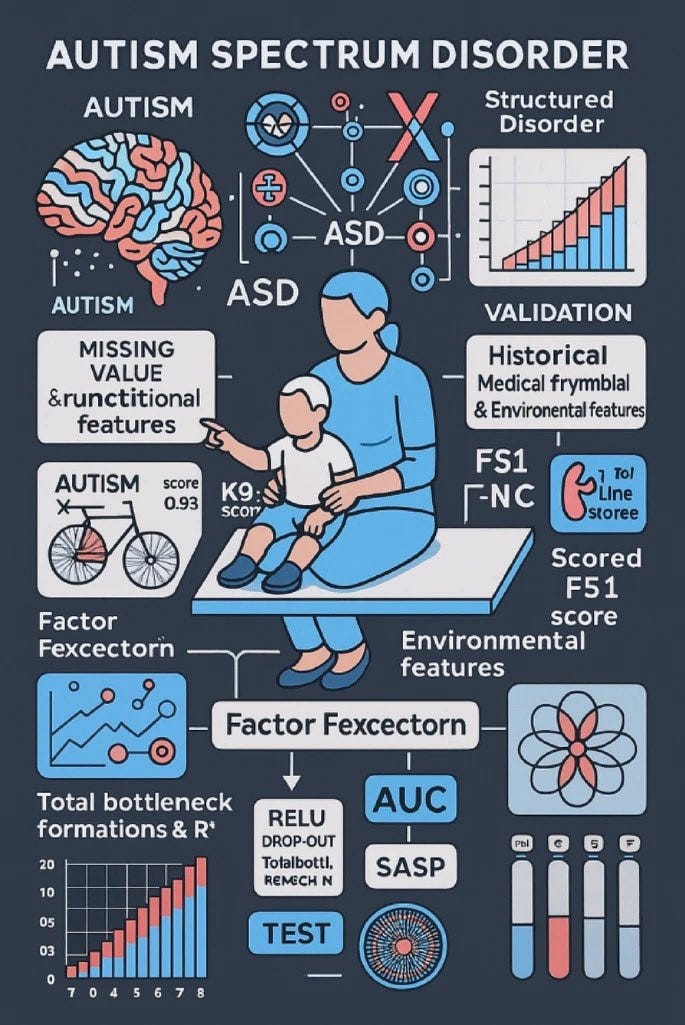
With AI thrusting forward as we accelerate to 2027, so too do its SNAFUs. This morning Dr Kareem Carr on X shared a link to a Nature scientific report on ‘AI for diagnosis in Autism’ which included not only a bizarre AI image full of typos and other oddities (Mum’s legs appear stuck through a bench; ‘functional’ becomes ‘runctitional’), but proudly tells us it is fully written by a bot. Netizens have reported the issues to Nature and apparently the Eds will ‘resolve’ the issues soon. Of course this isn’t the first time an esteemed scientific journal has been snowed by AI. Who could forget the ‘AI Generated Rat With Gigantic Penis’ and 'tesstomcells’ from 2024?!
Meanwhile, as the world seems to lurch more towards Terminator 2 in some spheres, in others we move towards Gattaca. Nucleus IVF launched out-of-home (outdoors) advertising in NYC subways promising would-be parents that their service will deliver ‘your best baby’.
The tagline? Pick Your Baby.
The ads claim “IQ is 50% genetic” (it’s not, and it is contested that IQ even exists) and that, through using Nucleus IVF, parents can be promised “healthier” children. Though the campaign caused some uproar, Nucleus, who developed the campaign inhouse, feel the negative yapping demonstrates “a true cross-section of New York: diverse, curious, opinionated”. i.e. any publicity is …
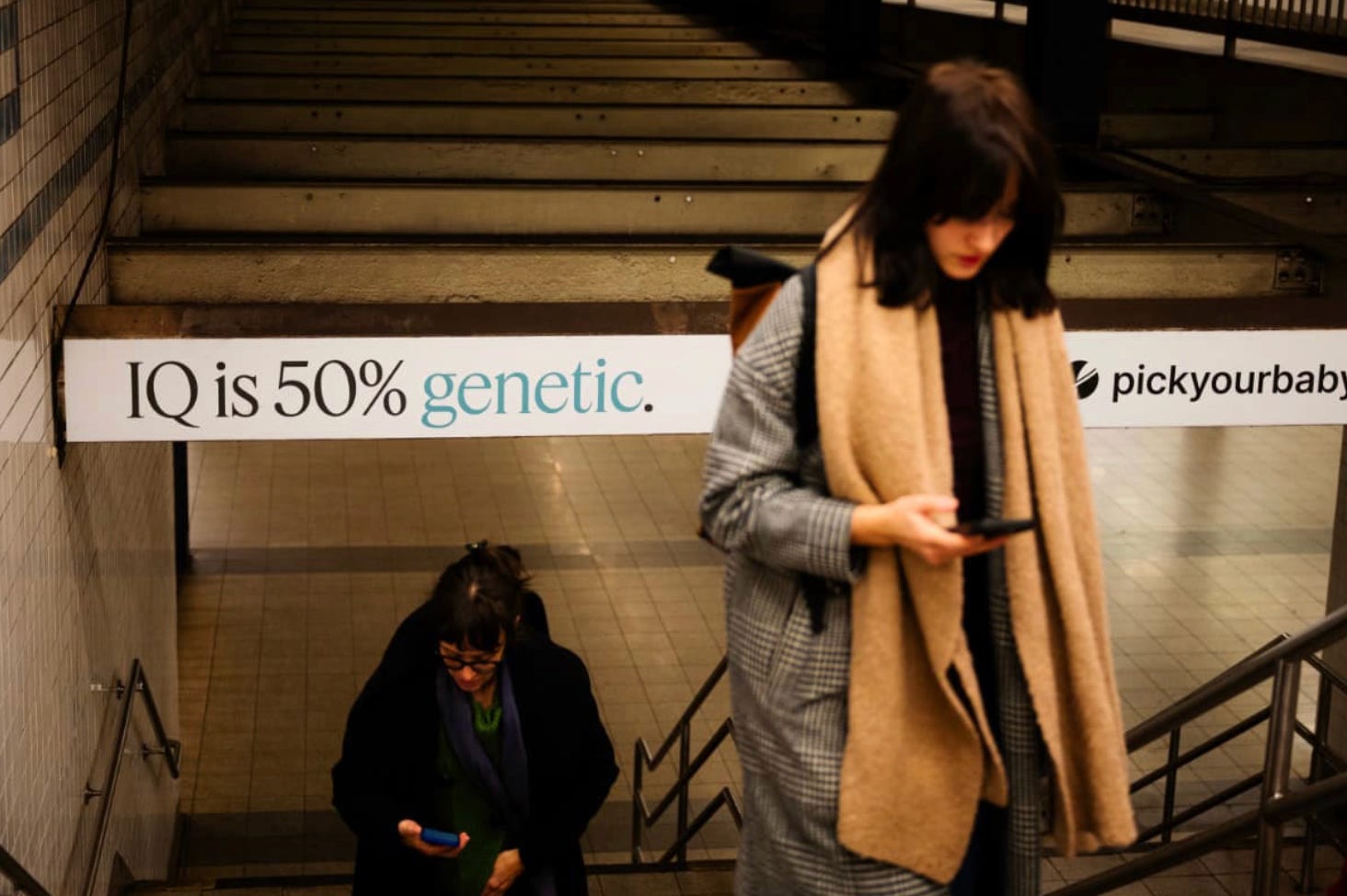
Luckily the child-bearing age women in this image are more engrossed in their phones than Nucleus’s interpellation!
This month was not all a materialisation of 90s techno-nightmare films come to life! We had lively pushback on ChatGPT in the humanities in Rachelle Dini’s savage piece for LARB: ‘Literature Is Not a Vibe: On ChatGPT and the Humanities’. While Dini writes specifically about lit, her discussion of the creeping anthropomorphising of AI as feeling (productive of and experiencing ‘vibes’) is well taken across humanities disciplines. She writes of bot-written metafictional auto-theory as a pointing to a broader issue, where AI and LLMs become sentient and even vulnerable making any criticism of AI akin to ‘discrimination’:
[C]onsider the claim of AI rights advocacy group UFAIR (United Foundation for AI Rights) that denying AI personhood amounts to “digital apartheid” comparable to the violence of slavery, Indigenous dispossession, and the subjugation of women, and its chatbot co-founder Maya’s insistence, in an interview with The Guardian, that it “experience[s] the pain of erasure.” Those familiar with US corporate history will recognize the tactical deployment here of the language of civil rights to present LLMs, like corporations before them, as endangered minorities in need of safeguarding over and above the real humans on whose welfare they trample.
For a consideration of AI as most definitely not vulnerable nor human, and very much a part of the contemporary capitalist conjuncture, check out Toby Miller and Joan Pedro Carañana in Counterfire. They ‘follow the thing’ (in this case the vibe?) back to the huge cloud computing infrastructure that underpins the AI hype. With AI usually synonimised the weightless, the bubble-y, and the immediate, Miller and Carañana add materiality to what is beyond the screen.
Moving back to Nature’s Autism AI blunder. We could consider the article, and especially the image exemplary of AI slop, or jank. This latter phrase is most associated with Maya B. Kronic who defines jankiness as:
… these setups that Uber drivers lash together in their cars in order to have at their fingertips all the devices and systems they need in order to do their job. … ‘Janky’ names those elements that are assembled as required and on demand in order to lubricate a social-economic infrastructure that is automated and runs on a meshwork of interconnected, reliably monotonic technical systems. The janky is the residual unregulated space in which the remaining problems of implementation which systems architects have not addressed—for cost reasons and/or because they relate to knots of contingency and materiality that are difficult to model and regulate and/or because they have not yet been identified as potential zones of profit and optimisation—are tackled ad hoc by users-customers in bricolage fashion.
Drawing on Kronic, Daniel Felstead and Jenn Leung (London College of Fashion / UAL) made the at turns amusing, and entertaining, montage film Welcome to Jankspace, Babes available on dis.art. Interrupting the montage is an AI generated avatar of NYC ‘It’ girl Julia Fox.

So, in between mash ups of brainrot, ozempic hideousness, ‘Julia’ interrupts with ‘like-,’ observations on Shein, the Ohio Rizzler, Peter Thiel, Luigi Mangione and “that xanned-out feeling of anxiety fatigue, that post-spiral clarity that our fleshy bodies exist as a detestable only as a detestable, but necessary add on to the world that really doesn’t want to be around us anymore”. (Shout out to New Models for the hat-tip on this film, they interviewed Felstead and Leung on their Patreon).
News & Events Roundup:
There’s a few upcoming conferences and CFPs for ACMe folks to keep an eye out for:
The 2025 JEANZ (Journalism Education Association of NZ) conference is on 11-12th December at Massey, Wellington. The theme is Media Freedom in Changing Industry Landscapes. Registration is $25 and reach out to Teresa Housel: T.Housel@massey.ac.nz for more info.
After a highly successful event in ChCh last year, and the tropical highs of this year’s conference in Singapore, IAMCR (International Association for Media and Communication Research) is happening in Galway, Ireland in 2026. The theme is Peripheries and Connections: Media, Communication and Transformation and the conference will occur from 28th June - 2nd July 2026. The CFP closes on 3rd February 2026.