

(accumulated by Brett Nicholls [Otago] / we will rotate ‘accumulators’ month by month - if you are an ACMe member and have some leads to include in the accumulation, drop us a line at acmesmokescreen -at- gmail etc.).
March begins with my social media feed being flooded with images of Melania Trump standing in for Donald Trump to chair a UN Security Council meeting on the pressing issue of children in conflict zones. Only a few days before the meeting, the United States empire backed the state of Israel and began bombing Iran. News emerged that a school had been bombed and more than 170 people, most of whom were children, had been brutally killed.
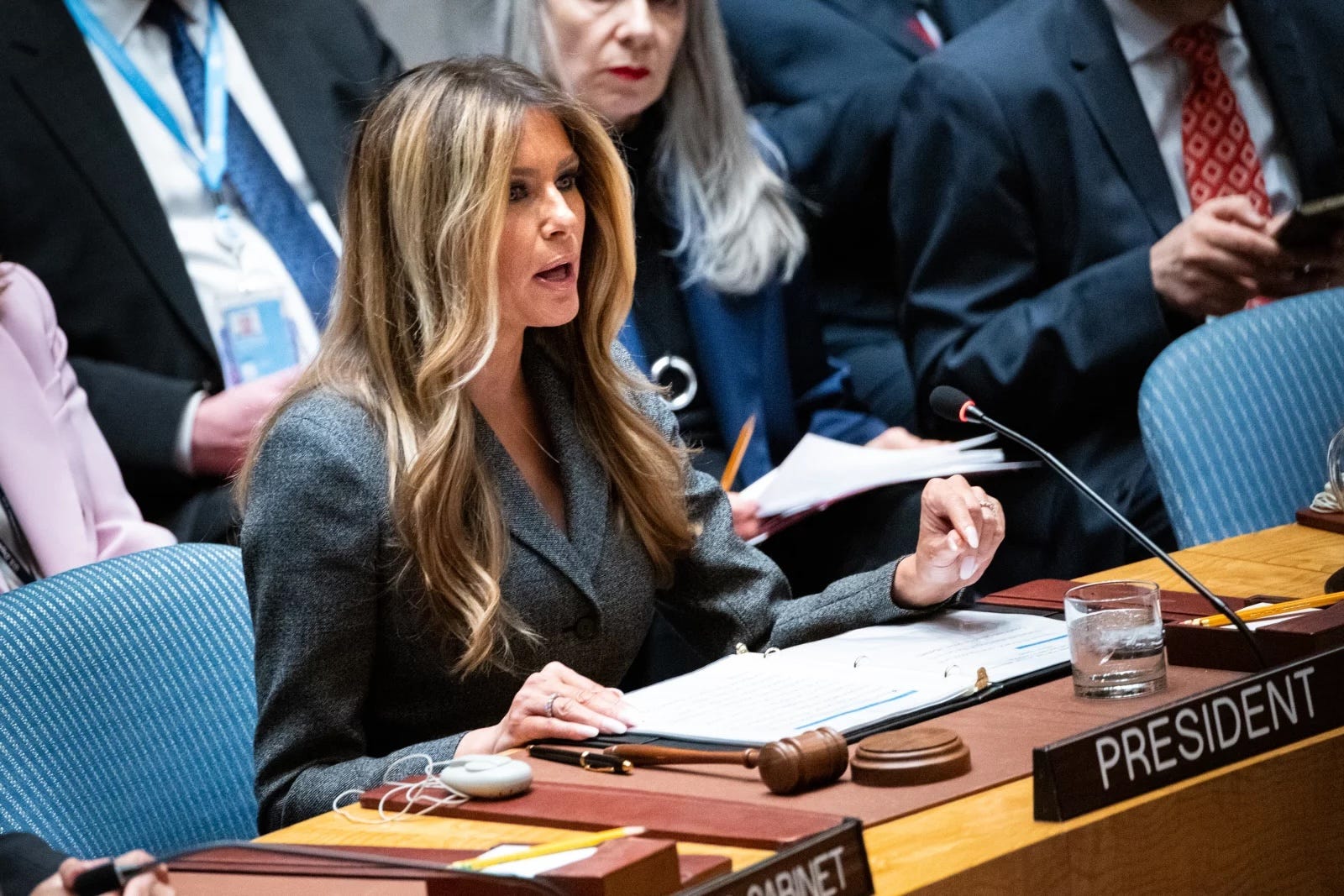
As NPR reported, “U.S. first lady Melania Trump presided over a U.N. Security Council meeting on Monday focusing on children in conflict, one of her signature issues, and acknowledged she was doing so in ‘challenging times’ as the United States has joined Israel in attacking Iran”. “The U.S. stands with all of the children throughout the world,” she said.
No doubt, the First Lady is to be applauded for this stand but no-one missed the sheer absurdity of the statement. This absurdity tells us how violence is made distinct from and yet is a part of state power’s expression of care and concern. Of course, the White House responded to disclosure of the bombed school with the usual rhetorical manoeuvres (it’s complicated, we are investigating!), knowing the news cycle would soon move on to something else. The ease with which power both acknowledges the calamity of its actions while distancing itself is shocking.
It would be tempting to say the First Lady is the ideological side of the Trump coin, with king Donald the material wrecker on the other. This would be too much of an opposition. It is more like a möbius strip where violence and care are either side of the same orientation. We loop incredulously and seamlessly from one to the other in these so-called ‘challenging times’. Baudrillard calls this movement hegemonic rather than dominating power in The Agony of Power (Semiotext(e) 2010): “Hegemony works through general masquerade, it relies on the excessive use of every sign and obscenity, the way it mocks its own values, and challenges the rest of the world by its cynicism”.
This mocking is perfectly illustrated by Robert Carter’s X post:
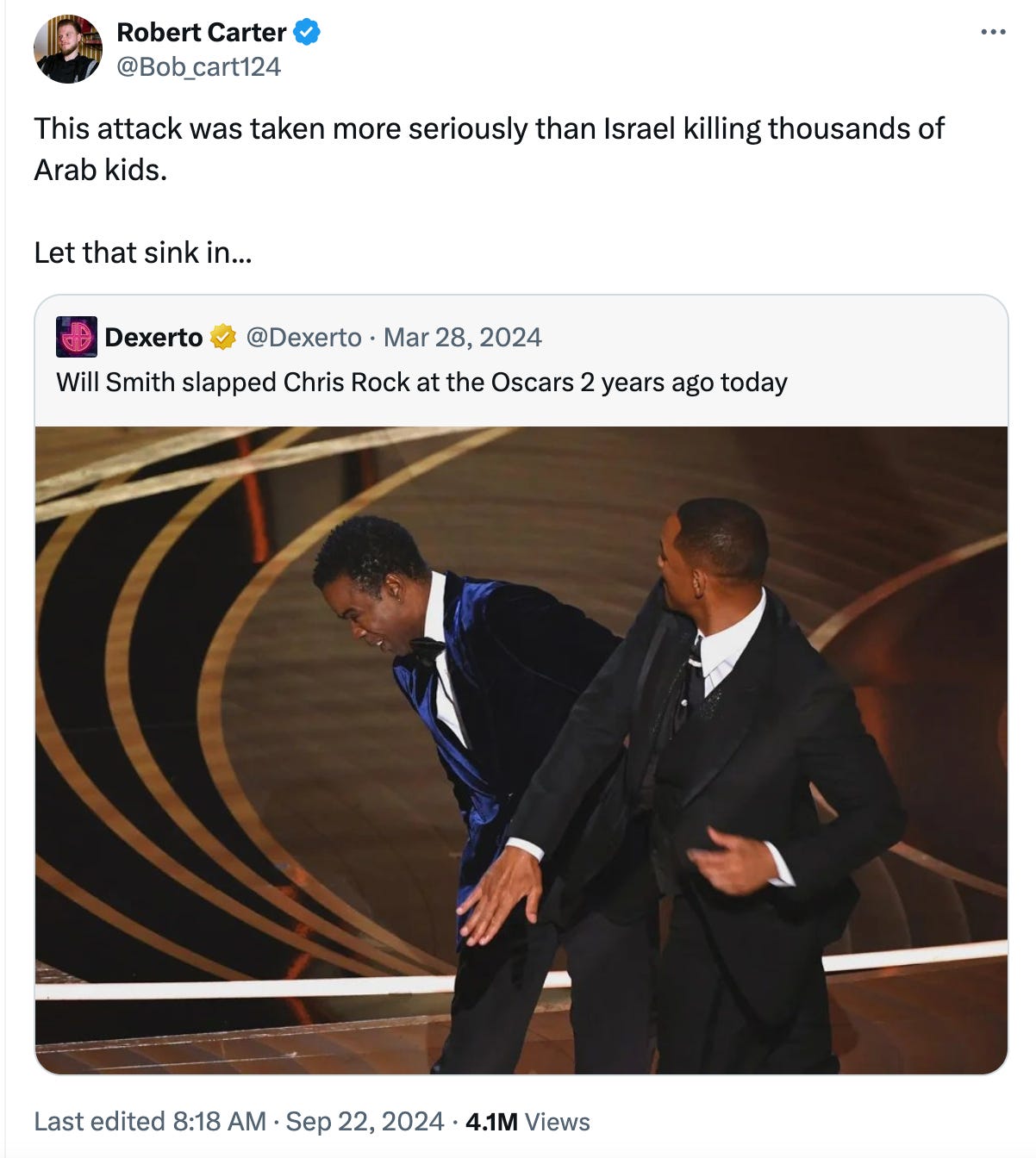
The fetishisation of celebrity cynically displaces a politics of accountability and consequence with an outrage that is political (is this slap justifiable?) and apolitical at the same time. This is political in the sense that it punctuates the social and requires us to make it mean something (Will Smith is out of line! No support for his films then!). And it is apolitical since nothing eventuates. The film industry continues, no doubt cynically enjoying the increase in publicity until the next scandal comes along.
This is a trite example. Surely there is no congruity between the slap and the ruthless military actions of the USA! Yet, as Anton Jäger points out in his excellent new book, Hyperpolitics (Verso 2026), such differences blur into one another: “ideological disorientation is a hallmark of the hyperpolitical age. Debate erupts over one issue today, another tomorrow. But individuals no longer possess a heuristic capable of unifying and imposing coherence on their various viewpoints.” We live at a time when people are politically active and politics is everywhere but solidarity and the necessary endurance of political movements have never been so far away (not since Feudalism).
This month also saw the passing of Jürgen Habermas. If Jäger’s diagnosis is right, Habermasian norms and communicative rationality are no longer on the political horizon.
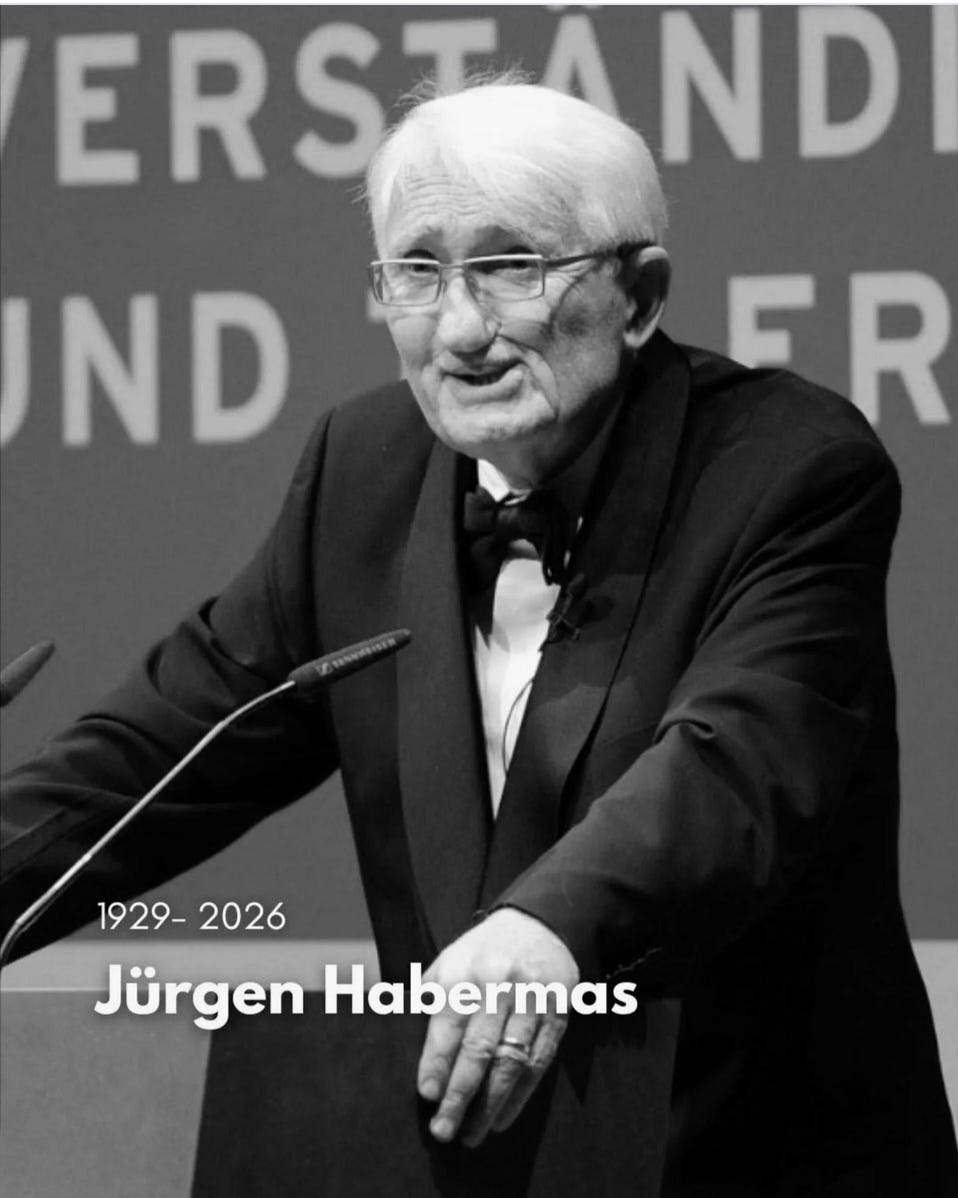
I first encountered Habermas in debates on the postmodern and power in the 1990s, in what Toby Miller called “the Murdoch garden”. In those days, we had to choose a side. I leaned toward Lyotard and Foucault. Others favoured Habermas. For me, Habermasian normativity belonged to a bygone era. Our time demands a new and more progressive problematic (beyond liberalism). At any rate, that tension was intellectually formative for the 1990s PhD generation.
As a young academic, I happened to meet Habermas in Germany. I spoke with him at length over a beer in an off street bar about his (mis)reading of Foucault (Yes, I am still dining out on this story). It is laughable to think about it now, especially considering no one talks about the postmodern any more (apart from reactionary pseudo-intellectuals and pundits). He generously listened to my rather thin objections and moved on to authoritatively outline his critique of postmodern politics. For material rather than ideal reasons, I thought at the time he is wrong (though we would need to carefully qualify Foucault’s ideal self-fashioning subject).
Habermas continued to be hopeful to the end for the structural transformation of the public sphere through social media but, given Jäger’s diagnosis, what we see today is the proliferation of politics. The public/private split no longer works as Habermas imagined. It has broken down. Politics is everywhere. It is precisely this excess (yes I still think what was called the postmodern is the problem we face) that allows the USA’s dreadful Trumpism to cynically and absurdly exercise its hegemony.
News and notes:
Upcoming events and Calls For Papers:
ACMe member, Nick Holm has been appointed the Aotearoa rep for the Cultural Studies Association of Australasia (CSAA). Nick is organising a Webinar series of 30-minute presentations. Slots are available in April, June and August. Reach out to Nick for details.
We have consolidated the CFP - anchored in conjunctural approaches to contemporary communications - for an ACMe presence at the December Social Sciences: He Kai Kei Aku Ringa conference at the University of Auckland. Contact Leon Salter or Chris McMillan for more details.
Other upcoming events which could highlight an ACMe presence are the Screen Studies Association of Australia and New Zealand conference at the University of Melbourne 1st-4th December; the theme is ‘making do’, and the Australian and New Zealand Communication Association conference at Murdoch University, Perth 24th-27th November; the theme is ‘storytelling in the age of disruption’. Contact Rosie Overell for more info.
Publications:
Rachel Billington published her monograph Adolescence, Identity, and the Politics of Recognition in the Social Media Era: Being and Becoming After the Alogorithmic Turn with Routledge.
Popular media appearances:
Rachel also provided commentary to RNZ about how young people experience global conflict via their screens.
Michael Daubs shared his thoughts on how Meta regulates what images are offensive (or worse) with stuff.co.nz. He also shared his expertise on Erica Stanford’s call for social media to ‘clean up their act’, also at stuff.