

After not seeing the sun all week, I spent my weekend at the theatre to fight off Seasonal Affective Disorder. One of the movies I watched was Marty Supreme (Josh Safdie, 2025). The almost slapstick scene when Marty Mauser goes down on Kay Stone in a field in Central Park, made me think about R.S. Benedict’s “Everyone Is Beautiful and Nobody Is Horny.”
In Marty Supreme, not everyone may be Hollywood beautiful, but the movie is plenty horny.
Marty Supreme, like every movie the Safdie brothers (together or on their own) have made, offers a splendid variety of faces and bodies. The Safdie Brothers’ big breakout film, Uncut Gems (Safdie Brothers, 2019), is filled with faces. So is Good Time (Safdie Brothers, 2017). The Smashing Machine (Benny Safdie, 2025), also released this year, may be the least Interesting Faces Safdie movie, even with all the cauliflower ears and fighting injuries. At the level of casting, Marty Supreme doesn’t look like most other Hollywood movies from 2025; it looks more like those pictures of 1970s sitcom casts that circulate on social media. No one looks healthy, and of course Marty could escape by running all of two city blocks. In 2020s tentpole pictures, Benedict writes, “Even background extras are good-looking, or at least inoffensively bland. No one is ugly. No one is really fat. Everyone is beautiful.” Marty Supreme achieves a density of interesting faces that would be close to normal in a New York-set movie made in the 1970s—The Taking of Pelham 123 to name one—bodies are not of uniform size or type. Nor are faces. A de-glammed Fran Drescher. The heavy and sweaty Larry Sloman. The heavy but less sweaty Luke Manley. Even Gwyneth Paltrow gets in on the action, sun damaged skin on her upper chest, tiny wrinkles at her eyes.
And then there’s Marty Mauser. Marty’s only supposed to be in his early twenties, but he looks older. Marty looks like he sleeps a hyperbaric chamber filled with cigarette smoke. And in a way, he does. It’s the 1950s, everyone smokes, and Marty barely finds time to work on his table tennis game, much less maintain a skin care and hydration routine. One very tight close up of Marty shows not just his monobrow and a terrible little moustache, but also acne scars. The horror. Between panic-driven scams, lies, and escaped beatings, Marty Mauser fucks. In a shoe store storage room, in a London hotel, and in Central Park, this scrawny unibrowed bullshitting little twerp Marty radiates what Benedict calls “sex-haver energy.” The same is true of Rachel, showing up at Marty’s work with a risible request to see the storage room, and Kay, who leaves her own opening night party for what turns out to be public sex.
A nice-looking movie star like Timothée Chalamet drastically altering their weight or appearance—uglying up—is a well-trod path to signal seriousness. There’s certainly some of that in Marty Supreme. But the quality of the faces across the entire cast manufactures a different kind of affective and even narrative authenticity. I texted a friend after the movie, and he texted back, “a table tennis movie got no right to be that stressful.” I’m tempted to say that Marty Supreme proceeds from the assumption that the presence of so many not-traditionally-beautiful people in a 2025 movie can generate its own form of tension or stress. Abel Ferrara, playing a mobster, looks like he has extra rows of teeth. He looks familiar with violence. Casting actual rich shitheads who look the part—grocery store billionaire John Catsimatidis, and Dragon’s Den / Shark Tank reality show star Kevin O’Leary—as Marty’s foils places their smugness and success against Marty’s sweaty grimy hustle. Lots of reviews noted that Marty agrees to a public bare-assed paddling to get to Japan for a match. Less frequently mentioned is that the smugly overfed O’Leary and his friends look like Soviet illustrations of capitalist fat cats. They are. All that money and they’re still ugly though. Benedict says of superhero movies, “everyone is only horny for war.” All O’Leary’s Rockwell and Catsimatidis’s Galanis are horny for is money and the power it affords them. Marty, on the other hand, is horny beyond reason and concern for personal safety, for his neighbour, the married Rachel, and Rockwell’s wife Kay. Marty may be almost entirely self-interested, but that small percentage that makes Rachel and Kay willing to put up with his shit shows that Marty isn’t horny for war. Generically, the sports bio offers satisfaction in the big victory. But Marty loses in the final of the British Open, agrees to throw an exhibition match, and then when he finally beats Koto Endo, the pyrrhic victory is self-destructive. A movie led by a star made to look New Hollywood beautiful (more Dustin Hoffman than Robert Redford), filled with not-Hollywood-beautiful faces and bodies, shows that someone like Marty, charismatic and driven as he is, can’t win but at least he can be horny.
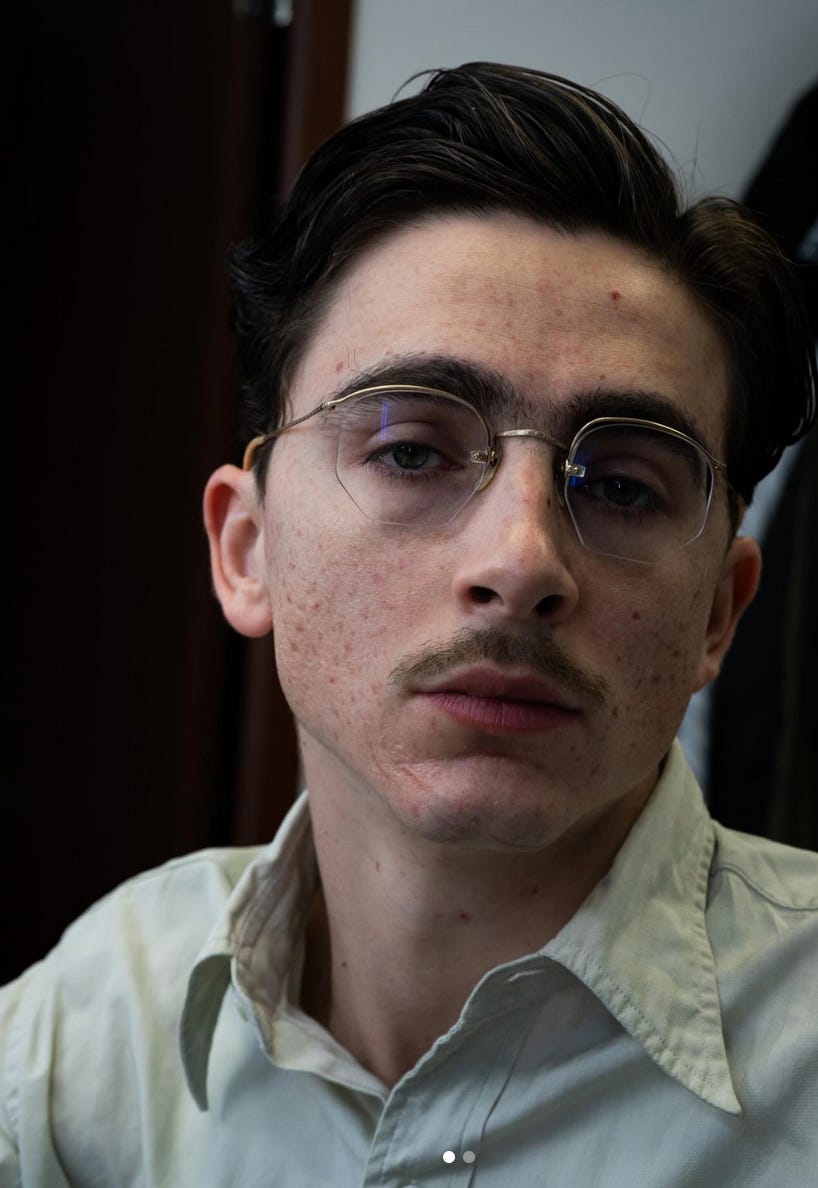
Timothée Chalamet in Marty Supreme (Josh Safdie, 2025). Makeup and prosthetics render him ‘ugly’. Image from tchalametdaily.
Christian B. Long is a senior lecturer in film studies at the University of Otago in Aotearoa New Zealand. He is the author of Infrastructure in Dystopian and Post-apocalyptic Film, 1968-2021 (2024) and The Imaginary Geography of Hollywood Cinema, 1960-2000 (2017), and the editor of ReFocus: The Films of Albert Brooks (2021) and Film and the American Presidency (Routledge 2015).
Fantastic read on how the Safdies flip beauty standards. The detail about casting actual billionaires like Catsimatidis and O'Leary as villains is kinda genius because their real-world smugness bleeds into the perfomance. It reminds me of how older New York films used authentic types to generate tension without relying on traditional villainy. The contrast between their overfed capitalist energy and Marty's grimy hustle creates class anxeity that's way more visceral than any script could manufacture alone.