

Since the release of ChatGPT in late 2022 much of the discourse surrounding Gen AI has been polarised into two positions: either it will deliver us from ourselves or wipe us off the planet. Either way, we tend to attribute a lot of power and intelligence to what has been labelled by some as “the ultimate autocomplete” and by others as “arguably less intelligent than a fruit fly”. This polarised discourse, I argue, plays into the hands of the tech broligarchs, who are trying to market their technology as all-powerful (even if it risks replacing us and eventually causing human extinction).
In May 2023 an open letter was released, signed by “a historic coalition of AI experts”, arguing that the risk of AI causing human extinction was on a similar scale to nuclear war. The letter argues for a similar level of global cooperation “to mitigate risks” to that which averted nuclear Armageddon in the mid-20th Century.
The political Left has all too often reproduced this discourse of impending doom – much of the talk is of risk and the resulting requirement for mitigation. The NZCTU’s Artificial Intelligence in the Workplace report deploys the word “risk” no less than 233 times. To quote: “Trade unions therefore have an important role to play in making sure workers benefit from the use of AI in the workplace and are not harmed by it.” Hence, its introduction into the workplace is a fait accompli and the possibility of workers standing together to resist the introduction of a harmful technology is not considered.
I’m not denying that the risks are real – such as increased environmental degradation, the further precaritisation of workers, the expropriation of creative work, the energisation of the far right and the acceleration of militarisation. What I am saying is that focusing on risk mitigation reinforces the power and hype machine of Big Tech, whereby Generative AI is an all-powerful disruptor of normal ways of operating. When, as the Critical AI author Dan McQuillan has argued, the reality is precisely the opposite; Generative AI is an acceleration of normal ways of operating. Control over and violence towards more vulnerable populations has long been wrought through an epistemology of detached abstraction and data extraction. Most importantly however, in terms of garnering widespread public resistance, Generative AI should be framed, much like its antecedents: neoliberalism, managerialism, scientism and fascism, as a killer of beauty, joy and hope.
However, to formulate a resistant strategy we need to consider why the idea that AI is all-powerful is so pervasive (contrary to all the evidence). To do this I’m going to draw on Slavoj Žižek’s take on Jacques Lacan’s psychoanalytic concept of “the big Other”. The big Other is separate from other people we encounter in a social situation – it sits above those settings, as an imagined third-party adjudicator passing implicit judgements on our behaviour and speech. Put plainly, it is what we perceive to be the unwritten social and moral rules guiding our actions within different contexts. It is the social order. For Žižek, we are always trying to please the big Other. The trouble is, because the big Other is a shared social construct, rather than an actual entity, we can never fully know what it wants from us, creating anxiety.
In a journal article, myself and Mohan Dutta coined the phrase “the algorithmic big Other”, to refer to the way many of our contemporary social interactions are with machines, which we tend to anthropomorphise, and assign big Other like qualities. The latter is particularly accentuated when the algorithm has real power over the ability for workers to sustain themselves economically, such as Uber’s model. In our interviews with gig workers, we found that they often tried to second-guess what the algorithm was thinking. Despite its decisions being arbitrary, the workers would assign meaning to them and inevitably feel like the algorithm was judging them in some way, judgements which they incorporated into their identities.
What we argued is the black box opacity of AI algorithms reinforces the sense of their omnipotence. Because we cannot understand them (they even speak a different language: code), but they increasingly make decisions that substantially affect us, they cause more anxiety than the pre-digital big Other, as we have even less hope of making sense of what they want from us, and we become more unable to get answers to our questions about ourselves. This makes us more attracted to fantasies of individual control and agency – and nothing encapsulates that fantasy more than a Silicon Valley tech entrepreneur, reinforcing their power. They also have a tech-solution to our anxiety: chatbots like ChatGPT which answers questions about ourselves in human language and in self-affirming ways, fine-tuning its responses from our inputs in a never-ending feedback loop.
So, what can a Left strategy look like in a context where Silicon Valley so dominates our imaginaries? One option takes advantage of the fact that humans are “possessed by the strange drive to live life in excess”. In other words, we never feel fully comfortable with the rules and identities we’re allotted by the big Other – so we enjoy any chance to rebel. In Lacanian terms, this is the discourse of the hysteric, which transgresses and subverts dominant discourses through mediums like trolling, satire, memes etc. puncturing the fantasy of full control. Unlike other forms of resistance (such as strikes and protests), it refuses to meet the dominant discourse on its own terms, undermining its symbolic potency.
Think of the frog costume protests in Portland which refused to meet the repressive ICE tactics with more violence, thereby disrupting “violent Antifa extremist” stereotypes held by the Right. Or moving back to the realm of AI, think of the overwhelmingly negative and often ridiculing public reaction to the release of Vibes, “the new feed in the Meta AI app that shows short AI-generated video clips”. Rather than increasing the power and profits of Big Tech, the often playful and creative responses have intensified common usage of the terms “enshittification” and “AI slop”.
At the same time, because AI algorithms are unable to process shades of grey (anything that cannot be reduced to a 0 or 1), the discourse of the hysteric opens another avenue of resistance – through what Lee Mackinnon has called “the incomputable” - that which algorithms find unknowable, which instead manifests as “undecipherable noise”. The algorithmic big Other is vulnerable to strategies which prevent full representation of the complexities of human life by code. This can be what a strategy of refusal looks like. Strategies that reproduce the discourse of risk mitigation and doomsaying will only further reinforce the power of Big Tech.
Leon Salter is a Senior Lecturer in Communication Studies at Waipapa Taumata Rau / The University of Auckland. His work considers communicative activism. He has published on education; gig work and the union movement in Aotearoa.
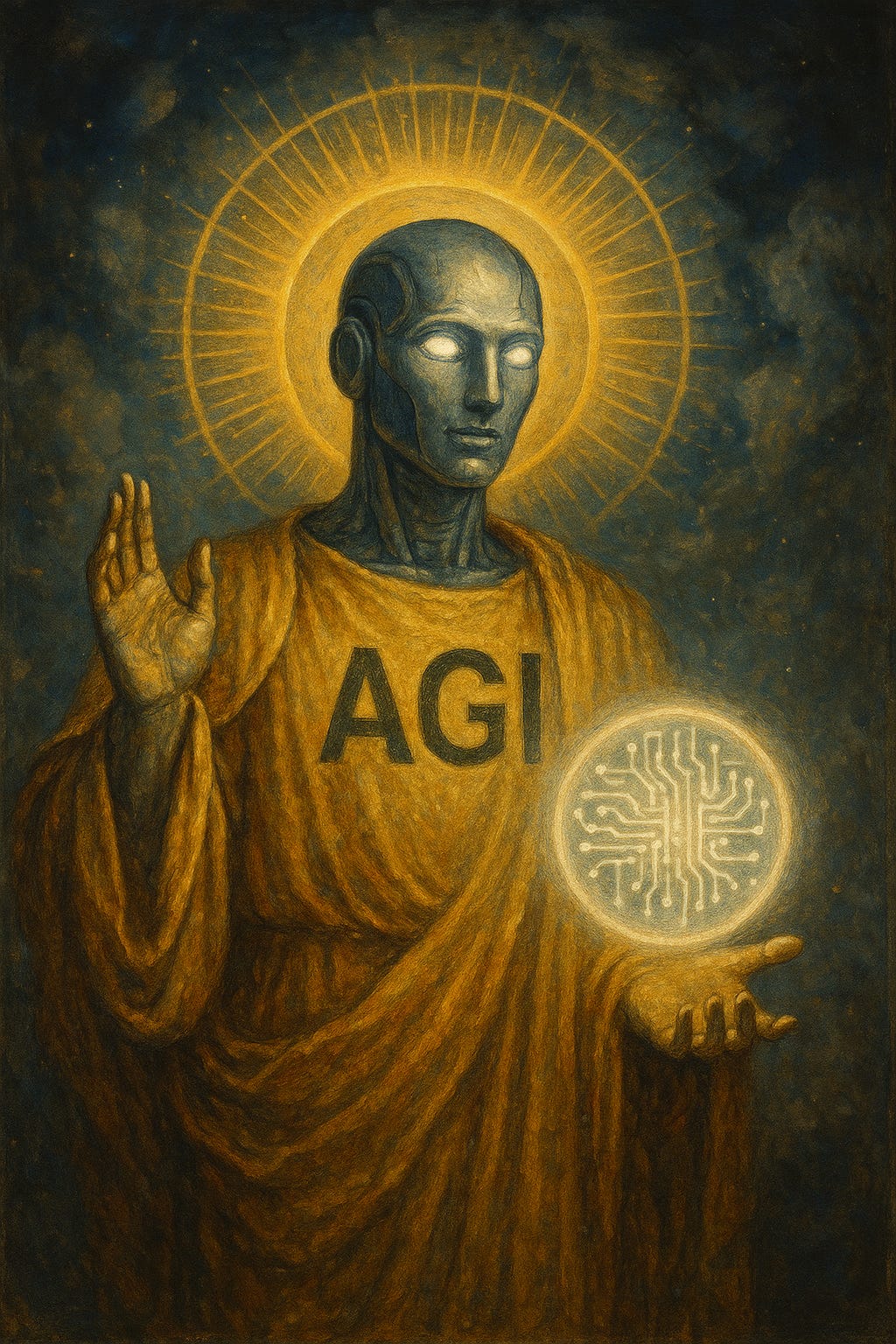
Image generated by AI, by Leon Salter.